A survivors’ tale of a Dutch East India shipwreck off the rocks at Hamburg
over 300 years ago when the Eastern Cape was a wildlife paradise and
Xhosafarmers produced a rich bounty: the goats were almost as big as cows!
In 1709 the Dutch East India Company (VOC) launched the Bennebroek (named after a small Dutch town) on its maiden voyage from Texel in The Netherlands to Ceylon (Sri Lanka). It was to be the ill-fated, 800-ton frigate’s first and last journey, ending in disaster off the coast near Hamburg.
An Internet search returns limited information about the wreck of the Bennebroek in 1713, some of it confusing, contradictory or even nonsense (ChatGPT, for example, says the ship went down near Clifton beach after initially saying the disaster happened in Australia! Other sources say it happened at Struisbaai/Cape Agulhas or along the Natal coast on different dates).
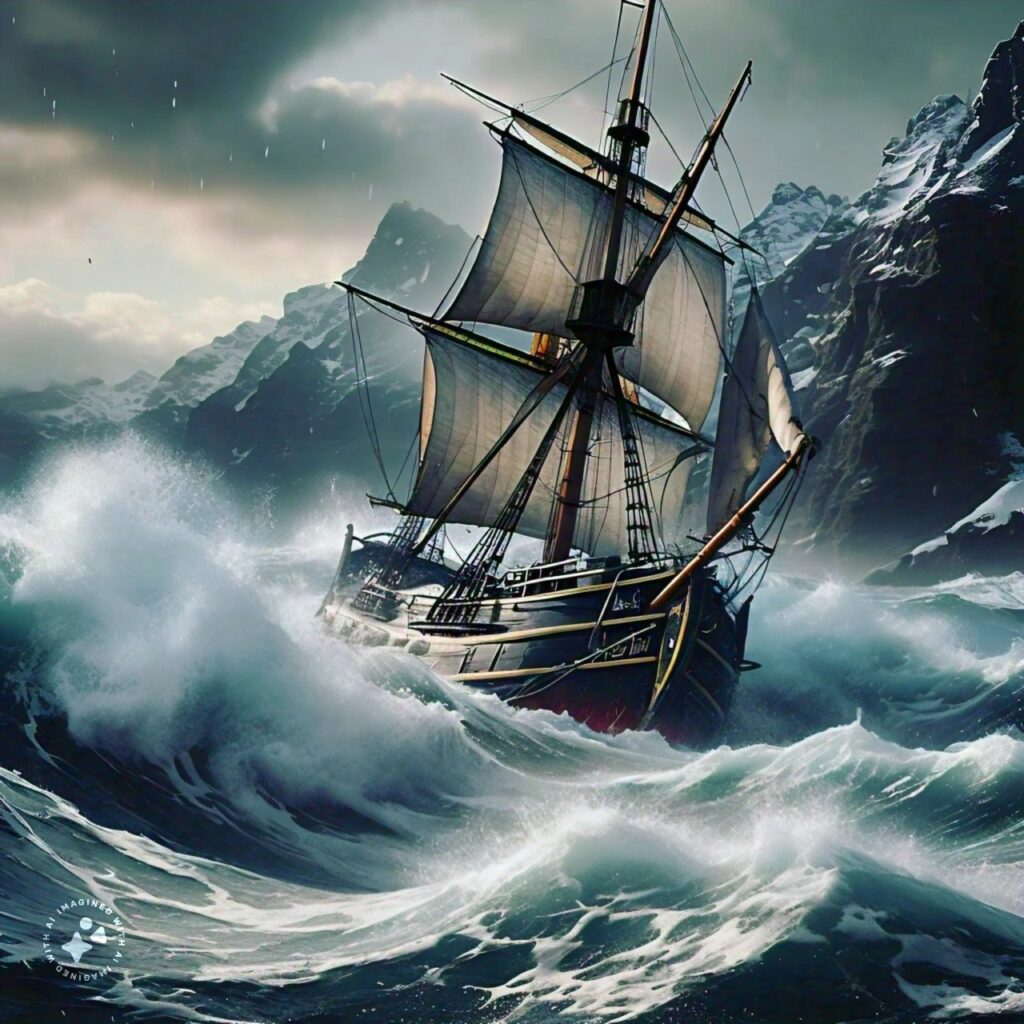
 Meta’s AI engine rendered this image when asked to visualise the Bennebroek smashing against the rocks.
But Hamburg’s own history sleuth, Tracy Mace, has ferreted out a first-hand account by Bennebroek survivors that was buried in the Cape Archive. It offers a fascinating record of misadventure, murder and fortitude. The eyewitness account also reveals the extraordinary range of wildlife and the abundance of wholesome foods produced by the Xhosa in the Hamburg area three centuries ago.
On her return voyage to Holland, the Bennebroek was laden with spices, textiles and Qing Dynasty porcelain from China. South-west of Ceylon the ship, in a fleet of five vessels, hit a storm and was separated from the convoy. Not long after, a second storm struck, and the Bennebroek was badly damaged with two of her masts broken.
Approaching the South African coast on the 16th of February 1713 she struck rocks near the Mtana River south of Hamburg and in the rough seas the ship began to break apart. Many of the passengers and crew, including the captain, Jan Hes, drowned; eventually only about 77 of the ship’s complement of 150 reached shore.
After a few day spent recovering from their ordeal the survivors decided to head overland to the Cape. On reaching the Great Fish River, most managed to swim across; 26 who could not swim were forced to return to the wreck site.
Of the survivors who crossed the river, all except one person who eventually made it to the Cape, vanished into history.
The group of 26 who returned to the wreck site lived off provisions bartered from the local Xhosa in return for iron nails and copper fittings salvaged from the wreck.
But by June of 1713 their supply of tradeable goods was exhausted and they made another attempt to reach the Cape.
A year later, four of the survivors were rescued by a small English-flagged ivory trading vessel en route from Delagoa Bay to Cape Town. They were discovered living in a coastal village near the mouth of an unknown river. The boat, the Clapman Galley, docked in Cape Town on 4 September 1714.
Back in the Cape, three of the survivors wrote up a record of the disaster and its aftermath. They signed the document “Marchand, Fred. Jansz and Gerrit van den Pyper”, which was located by Tracy Mace in the Cape Archive. Here are some excerpts from that document.
“Shortly after leaving Q-alle Bay (a fortnight) a violent storm overtook them, separating the Bennebroek from its consorts. A month afterwards the ship was in latitude 31 when it was overtaken by another violent tempest, lasting 24 hours. On Thursday, 16th February 1713, they saw to their terror land on their lee, and shortly afterwards the vessel struck on the rocks, and filled at once. Two hours later she parted asunder, many having already been drowned, including the skipper …
Another Meta AI image of a Dutch frigate in deep trouble.
“Some were saved on pieces of the wreck, which, however, also killed or smashed others. 57 Europeans and 20 blacks were saved, convicts and slaves. The survivors had remained on the spot four days; on the first day, however, the vessel had entirely broken up; consequently they decided to proceed to the Cape overland. Had five guns, powder, lead, salt meat and pork whilst skirting the shore.
“Five days afterwards they were checked by a swift and broad stream and compelled to return, i.e. 17 Europeans and 9 blacks. The rest, including the two mates, intending to go on.”
Those who stayed behind returned to a tent near the site of the wreck. The report continues:
“Here they remained until the 6th June, supporting themselves with milk, beef and a nice sort of grain which they obtained from certain natives, called Xhosas, who were no(t) Hottentots, for iron and copper which we could still find from the ship. But as they (the Xhosas) gave nothing for nothing, they were again obliged to make an attempt for the Cape higher up over land, and above the rivers’ sources, very many being unable to swim.
“Three Europeans and one black were left in the tent, they were too weak or too small to go with us. After 29 days wandering and three and a half days walk along the river bed searching for a fort, but in vain, we returned to the tent because our provisions and water were exhausted, the river being salt.”
On returning to the tent, the group found the blood-stained clothing of their shipmates who had remained behind, but no bodies. Their stores had been looted. The killings may have been committed by Hottentot “strandlopers” who were warring with the Xhosas in the area. The report continues:
“We concluded that our mates had been murdered, and at once proceeded to the Xhosas who supported us in their own way with food for more than 12 months … “
The report goes on to describe the abundance of animal- and birdlife that surrounded them.
“We found very fat cattle there, beautiful pastures, goats, fowls, lions, elephants, rhinoceroses, tigers, wolves, foxes, hares, rabbits, elands, harts, seacows, buffaloes, steenbucks, and wild horses. The goats were almost as large as cows.
“There were also parrots, magpies, crows, bush doves, and turtle doves. Likewise, a multitude of other feathered and wild animals, which we had no name for.
“There is therefore no want of food there. Moreover, the grain is found there, of which we have brought a sample, and of which the natives make nice and nourishing bread, breaking it on a stone with water, turning it into balls and then baking it.
“We found no vegetables except pumpkins, gourds, and water-melons. The natives among whom we remained about 18 months we believe to be Xhosas, being black, well formed, flat nosed, and having Xhosa hair. Like the Hottentots, their clothes are made of skins. They were not savagely disposed towards us, but wished to persuade us to remain longer, so that we promised to return after three years in order to be able to get away.
“They are, however, in endless war with the lighter coloured Hottentots. We found a European among them, about 80 years old, who had been wrecked on the coast about 30 years previously in a Dutch return ship (the ” Stavenis” perhaps) in which he served as cook, and which had left Zealand in 1683. The skipper’s name was David Appelman. He is a born Frenchman, and lives there happily in native fashion. Whether it was caused by his disposition or birth, we don’t know, but the Xhosas showed us more civility than they did to the old man.”
“After that the little boat (The English trading vessel that rescued them) arrived in the river there, and with her we came hither. We left the river on the 17th August 1714, and touched at another place bartering about 3,000 Ibs. ivory for yellow copper rings. The boat, as was stated, had been expressly made for the purpose.”
The report ends abruptly.
(Signed by) Marchand, Fred. Jansz, and Gerrit van den Pyper
The Bennebroek lay undisturbed on the ocean floor until 1985 when a salvage operation led by diver Peter Sachs in collaboration with the East London Museum, recovered bronze cannon, anchors and large quantities of Chinese Qing Dynasty porcelain.
Small chips of the Bennebroek’s porcelain hoard continue to wash up on the beaches of Hamburg to this day, to the delight of amateur treasure hunters.
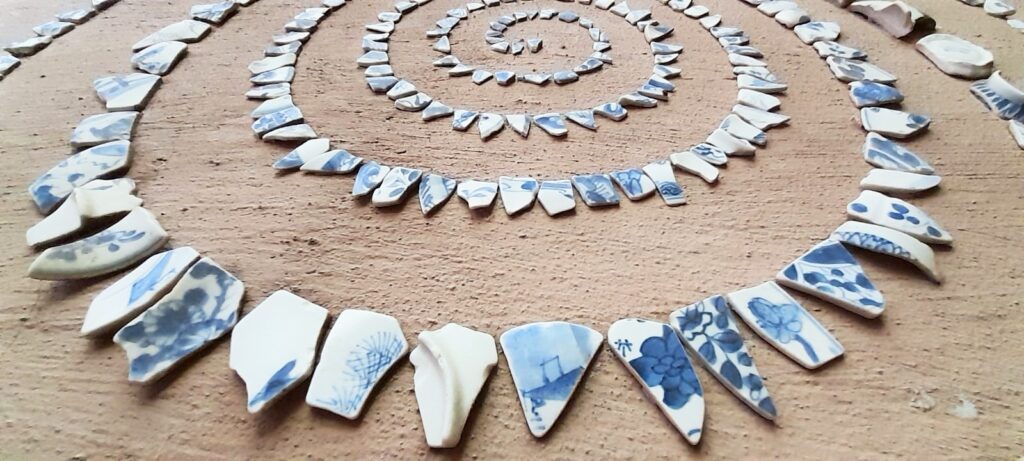
Hamburg artist Toni-Ann Ballenden’s collection of Bennebroek porcelain pieces that have been washing up on the beach for hundreds of years.